







A static ad is the asset nobody plans for and everybody needs. A square that fills a catalogue slot. A 4:5 that goes back into rotation when a video fatigues. A story frame that explains the offer before anything moves. A static ad generator is what lets that layer get produced at the rate paid social consumes it, instead of waiting on a shoot every time a headline changes.
Adssmith is an AI ad creative generator built for that specific job. You point it at a product, it reads the imagery and the copy you already published, and it composes finished image ads from your own photography. Nothing is redrawn, nothing is lifted from a stock library, and no template file sits between you and the ad.
What a static ad generator actually does
Two different tools get filed under the same name, and the difference decides whether the output is usable in a live account.
The first is a layout tool. You bring a cut-out product image and a background, and it arranges a headline, a logo and an offer badge on a canvas. It is fast and predictable, but it cannot create the scene, so the result looks like every other template ad in the same category.
The second is generative. It can build a scene that suits the product, but a general image model will happily redraw the label, alter the proportions and drift the colour until the asset is prettier and wrong.
A static ad generator worth using does both halves in the right order: it generates the composition, then holds the product and the brand fixed while it does so. Adssmith runs generation image-to-image against your own product photography, so your pixels are the anchor and the scene is built around them. What comes out is a finished still image at the ratio the placement expects, with the headline and description still editable afterwards.
Why static ads still carry the account
Video earns the attention; statics do the rest of the work. Catalogue placements, retargeting units, search-adjacent inventory and most of the test budget run on still images, because a still is cheap to serve and instant to read.
Statics are also the fastest thing to iterate. Change a headline on a video and the whole timeline has to be rebuilt; change a headline on a static and only the words move. That is why the static layer is where most accounts find their angle, and why a thin static supply is usually described as a creative problem when it is really a throughput problem.
What breaks when you generate statics with a general image model
Three failures show up in live accounts.
The first is fidelity. Image models are trained to produce a plausible picture, not an accurate one, so a generated product comes back with invented lettering, slightly wrong proportions or a material that no longer matches what ships. For a store running its own catalogue, that is a promise the customer will not receive, paid for in returns.
The second is typography. Models that draw letters produce near-miss type. A logo rendered by a generative model is a corrupted logo, and it reads as careless even to someone who could not name what changed.
The third is continuity. Each generation is a fresh interpretation, so a set of ten ads can look like ten different companies. Brand consistency is not decoration; it is how a customer recognises you between two taps.
Adssmith's answer to all three is the same: extract the constraints first, then generate inside them. Palette, type and imagery style come from your own storefront, product geometry comes from your own photograph, and the text layer is set rather than drawn.
From one product photo to a finished static ad
The pipeline is deliberately short.
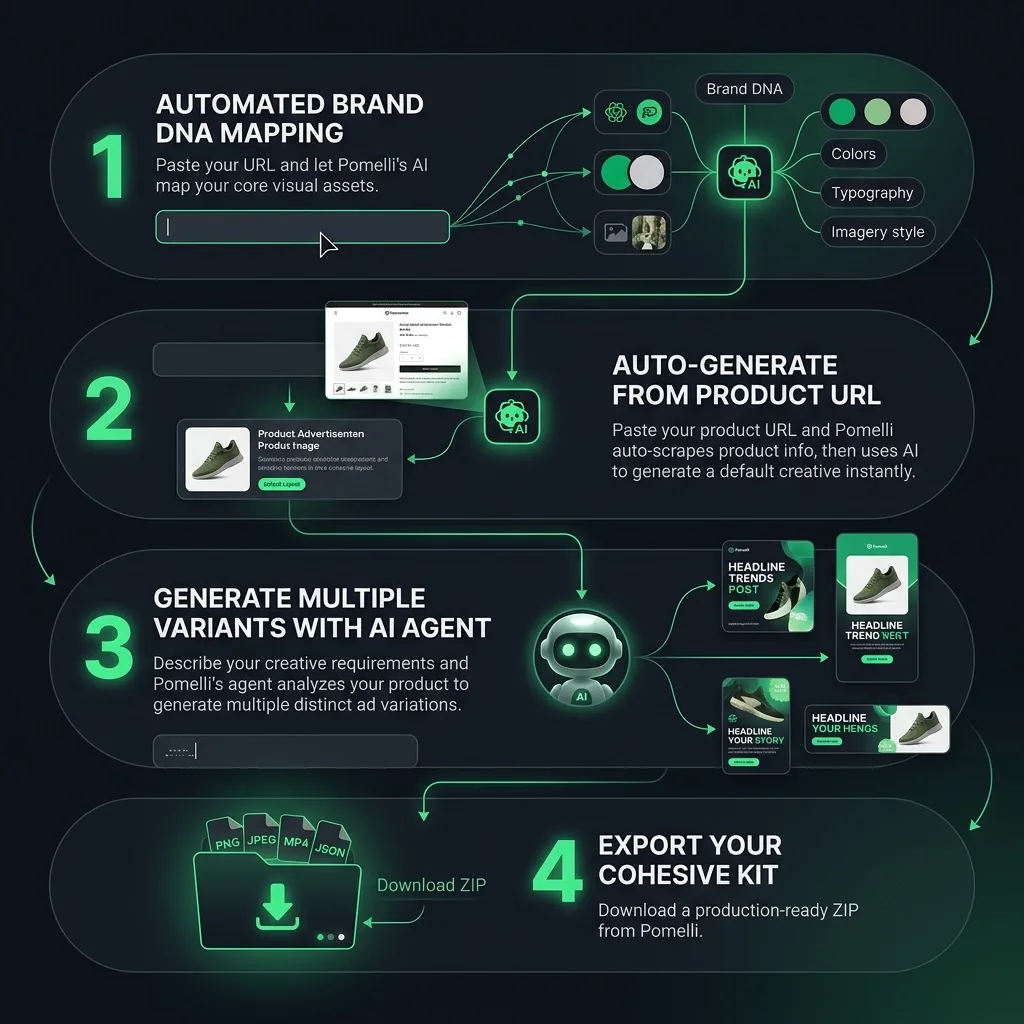
It starts with the product. A product page URL gives the best result, because Adssmith can read the imagery, the selling points and the audience directly from the page. A single clean product photograph works too, and a service with no product detail page can start from brand materials instead.
Next, brand DNA is mapped. This is the pass that makes everything after it look related: colours, typography and imagery style are captured as rules, so a later generation is not free to invent a new art direction.
Then the statics are composed. The scene changes, the angle changes, the offer framing changes. What does not change is the product, which is why a set can go into a live account without a repair pass.
Finally you choose what ships. Headlines can be rewritten without regenerating the visual, so a copy test costs a text edit rather than another production cycle.
The parts you should not automate
A generator can hold a brand. It cannot audit a claim. Discounts expire, offer copy goes stale, and an invented testimonial or result is a legal problem rather than a design one, so a human still signs off on anything that promises something.
It is also worth keeping one deliberate review pass on dense offer ads, where headline, badge and body copy all compete for the same square. Composition can be automated; hierarchy decisions are judgement.
How to test statics without drowning in them
Keep one variable moving. If the scene and the headline and the offer all change between two assets, the result tells you nothing about which one worked.
Choose the constant first, then generate around it. Same product, same framing, different headline is a copy test. Same headline, different scene is a creative test. In both cases the product stays where it is, which is what makes the comparison mean anything.
Let the placement decide the composition rather than cropping one master file four ways. A 9:16 that started life as a square will put your product behind a caption bar; a 9:16 composed as a 9:16 will not.
Start with the photo you already have
The bottleneck in static production has never been ideas. It is the number of finished, on-brand images you can put in front of an audience this week. If you have product photography and a storefront, you already have the input. Paste the URL and see whether your product survives the generation with its label, its proportions and its brand intact. The structural decisions behind those statics are catalogued in the ad creative examples gallery, and the pipeline itself is walked through in how Adssmith works.